TANJI
Product Strategy Proposal: ‘Gold Plan’ for Enhancing User Engagement

Executive summary
To optimize the application process for ‘Part-time Job Finder’ by using a scheduling system, rating mechanism, and skill badges, improving job matching efficiency, user engagement, and market competitiveness, while exploring the potential of the business model.
Category
Business Ideation
Skills
Business Strategy
Competitor Analysis
Feature Planning
Team Members
(Discussion Phase)
UX Researcher
Implement
Proposal Stage
1 Month
(2024/9-2024/10)
Background
To boost ‘Tanji’’s competitiveness in the Taiwan part-time job market, we conducted competitive analysis and user research to build a new job-seeking strategy—eliminating the application process. We also tested the feasibility of localizing the successful Japanese business model.
Target Audience
B2B Users: Employers and small businesses in Taiwan seeking talent.
B2C Users: Students and part-time job seekers in Taiwan.
Research
The competitive analysis dives deep into market opportunities, while user journey comparison accurately identifies current pain points and user needs.
Product Metrics
Increase daily active users and frequency of feature usage to enhance user stickiness.

Pros: Designed for part-time job seekers, with a tailored resume and user interface that’s intuitive and easy to use.
Cons: The “Chat" feature provides deeper insights into job requirements but may incur higher time costs.
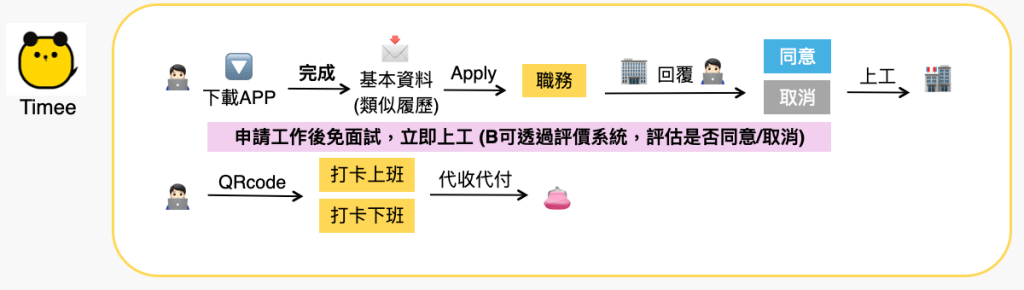
Pros: Eliminates the time spent on posting and interviewing (which usually takes 2-3 weeks), greatly shortens the process, and allows quick decisions based on evaluation records to determine job suitability.
Cons: The successful Japanese business model must be localized for Taiwan, taking cultural differences and user characteristics into account to ensure market adaptation.
Pain Points
• Job seekers cannot quickly identify available job slots.
• The “Chat" feature, while useful for in-depth job discussions, incurs a higher time cost.
• The application process is lengthy, similar to full-time jobs.
Solution
Focusing on optimizing user experience, the solution innovates matching methods and designs features more suited to part-time job seekers, improving application process efficiency.
Strategy
Phase 1: Scheduling System
• Implement a “shift filter" function to select the job seekers who are suitable.
• Provide a scheduling calendar for both job seekers and employers to view available time slots clearly.
Phase 2: Evaluation System Replacing Resumes
• Employers can evaluate candidates, eliminating the need for lengthy resume reviews.
• Reduce “Chatting," accelerating the matching process.
Phase 3: Skill Badge System
• Employers can issue skill badges to job seekers, strengthening skill recognition.
• Job seekers can enhance their skills by collecting badges, increasing job application motivation.
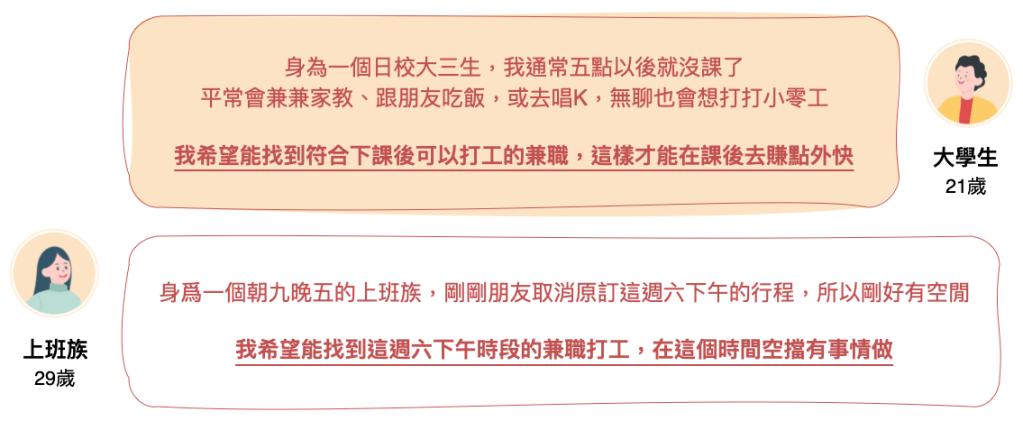
▲ User Profile Assumptions for Strategy
Risks and Challenges
• Scheduling System: Must coexist with the existing “Chat" function, avoiding disruption of user habits.
• Evaluation System: Needs to address the cold start issue of new users lacking evaluations.
MVP Concept
• Job Seekers: Apply for jobs on a daily basis.
• Employers: Use the evaluation system to quickly filter suitable candidates.

A/B Testing
Compare user acceptance between the traditional application process and the scheduling system.
| Experiment | Variant | Traffic Distribution | Group |
| A | Traditional Application Process | 50% | Control Group |
| B | Scheduling System Process | 50% | Test Group |
Outcome
The company’s current main objective is to attract the next generation of students who are likely to become resume members, so this proposal is deprioritized for future implementation.
 Crystal G.